★ TECH DEEP-DIVE · 2026
🤖 How NSFW AI actually works: under the hood.
You talk to her, she talks back. She generates pictures, remembers your kinks, and sounds increasingly real on voice calls. But what's actually happening inside these apps? This guide breaks down the tech — LLMs, fine-tuning, image generation, voice synthesis — in plain English. No PhD required.
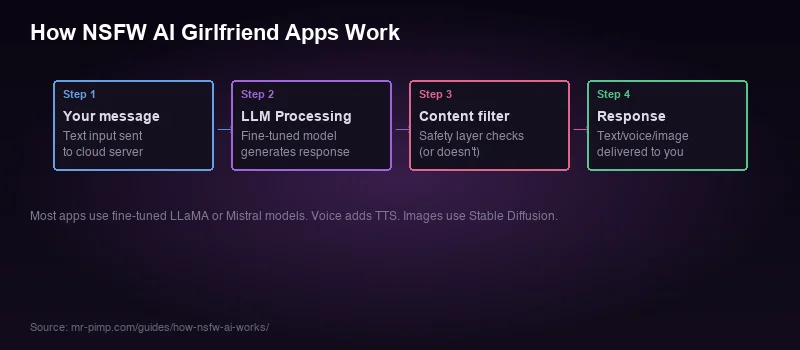
The short version: NSFW AI girlfriends run on large language models (LLMs) fine-tuned to remove safety filters. Image generation uses diffusion models. Voice uses text-to-speech synthesis. The quality differences between apps come down to model size, fine-tuning quality, and how much GPU compute they're willing to burn per message. GoLove currently runs the best stack for the price.
1. 🧠 What is an LLM (plain English, no PhD required)
Every AI girlfriend app is powered by a large language model — an LLM. Think of it as a massive pattern-matching engine that's read the internet and learned how humans write.
Here's the simplified version: an LLM is a neural network with billions of "parameters" (think of them as knobs). During training, the model reads enormous amounts of text — books, forums, articles, dialogue — and adjusts those knobs so it can predict what word comes next in a sentence. Do this enough times with enough data, and the model starts producing text that feels like conversation.
It doesn't "think." It doesn't have feelings, desires, or consciousness. It's doing extremely sophisticated autocomplete — predicting the most likely next token (word fragment) based on everything that came before it. When your AI girlfriend says "I missed you," she's producing a statistically likely response to your input, not experiencing loneliness.
The most common base models used in NSFW apps right now:
- LLaMA 3 / 3.1 (Meta) — open-source, widely used. Most budget apps run fine-tuned versions of LLaMA.
- Mistral / Mixtral — French-made, efficient. Popular for apps that need speed over raw quality.
- Custom proprietary models — some premium apps (like GoLove and Kindroid) train or heavily customize their own models.
The size matters: a 7-billion-parameter model is faster but dumber. A 70-billion-parameter model is slower but handles nuance, memory, and complex scenarios significantly better. Most quality NSFW apps run 13B–70B models.
2. ⚙️ How apps fine-tune for NSFW
Base models like LLaMA come with safety filters baked in — they'll refuse explicit content by default. NSFW apps need to remove or bypass those filters. There are three main approaches:
RLHF (Reinforcement Learning from Human Feedback): human reviewers rate the model's NSFW outputs. "This response was good, this one was awkward, this one broke character." The model learns from those ratings. This is the most expensive method but produces the most natural results. GoLove uses this approach, and it shows in conversation quality.
DPO (Direct Preference Optimization): a newer, cheaper alternative to RLHF. Instead of real-time human feedback, the model is trained on pre-collected pairs of "better" and "worse" responses. Faster to train, slightly less refined. Most mid-tier apps use DPO or a hybrid approach.
Uncensored base models: some open-source projects release models that were trained from scratch without safety filters, or had their safety training explicitly reversed. Apps built on these skip the fine-tuning step and start from an already-unrestricted foundation. Cheaper, but quality depends entirely on the base model.
Why this matters to you: the fine-tuning method directly affects how natural conversations feel. RLHF-tuned apps maintain character consistency and handle complex scenarios. DPO apps are decent but sometimes "drift" out of character. Apps using raw uncensored models can feel inconsistent — great one message, robotic the next.
The dataset matters too. Apps that fine-tune on high-quality erotic fiction and authentic roleplay dialogue produce dramatically better results than those trained on low-quality forum posts or generated synthetic data. This is where Candy AI struggles compared to GoLove — same model class, very different training data.
3. 🔥 Why some apps "feel smarter"
You've probably noticed: some AI girlfriends feel genuinely engaging while others feel like talking to a chatbot from 2019. The difference comes down to three technical factors:
Model size: bigger models = better conversation. A 70B-parameter model understands sarcasm, subtext, and emotional nuance. A 7B model gives you generic responses. Most users can feel the difference immediately without knowing why.
Context window: this is how much of the conversation the AI can "see" at once. A 4K context window means the AI only remembers the last ~3,000 words. A 32K window remembers the last ~24,000 words. Apps with tiny windows "forget" what you discussed 20 messages ago. Apps with large windows maintain continuity across long conversations.
- GoLove — 32K context, persistent memory system on top. Remembers details across sessions.
- Kindroid — 16K context with RAG-based memory. Good long-term recall.
- Candy AI — 8K context. Noticeable forgetfulness in longer chats.
- SpicyChat — varies by character creator. Often 4K. Very forgetful.
System prompts: the hidden instructions that shape personality. Every AI girlfriend has a "system prompt" — a block of text the user never sees that tells the model who it is, how to behave, what to remember, and how to respond. A well-crafted system prompt is the difference between a generic chatbot and a character that feels alive. Premium apps invest heavily in prompt engineering; budget apps use templates.
When someone says "this app just gets me" — it's not magic. It's a big model + long context + excellent system prompt. That's the formula.
4. 🔥 What "uncensored" really means
Marketing loves the word "uncensored." But there are actually two very different things it can mean:
Type 1: Trained without safety filters. The model was built from the ground up without learning to refuse. It never learned "I can't do that" because that phrase was never in its training data. These models are genuinely uncensored — they don't have a safety layer to "break through" because one was never installed.
Type 2: Safety filters removed after training (jailbroken). The model was originally trained with safety filters (like ChatGPT or base LLaMA), and then those filters were fine-tuned away or bypassed with prompt engineering. These models can and sometimes do slip back into refusal mode, especially with edge-case requests. You'll see this as the AI suddenly saying "I can't engage with that" mid-roleplay.
How to tell the difference as a user:
- Consistent NSFW = Type 1. The AI never hesitates, never breaks character to refuse, never gives you a safety disclaimer mid-scene. GoLove and Kindroid run Type 1 models.
- Occasional refusals = Type 2. The AI is usually fine but sometimes randomly refuses or adds "I want to remind you that..." disclaimers. This happens with apps running jailbroken versions of commercial models.
Neither type has "morality." The model doesn't know what it's generating. Type 1 never learned to refuse. Type 2 learned to refuse, then had that training partially reversed. Neither is making ethical judgments — one just has a more consistent output.
5. 🎨 Image generation: diffusion models, LoRAs, and why quality varies
When your AI girlfriend "sends you a photo," here's what's actually happening:
Diffusion models are the engine. The most common is Stable Diffusion (or custom forks of it). The process: start with pure random noise, then progressively "denoise" it step by step, guided by your text prompt, until an image emerges. More steps = higher quality but slower generation.
LoRAs (Low-Rank Adaptations) are small add-on models that customize the base model for specific styles or characters. Want your AI girlfriend to have a consistent face across all generated images? That's a LoRA trained on that specific character's appearance. Want anime style instead of photorealistic? Different LoRA. The quality of the LoRA directly determines whether images look coherent or like a face-swapped nightmare.
Why quality varies so much between apps:
- Base model version — SDXL produces dramatically better images than SD 1.5, but costs more compute.
- Custom LoRAs — apps that train their own LoRAs get consistent characters. Apps using generic public LoRAs get inconsistent faces.
- Inference steps — 20 steps = fast but rough. 50 steps = slow but polished. Budget apps cut corners here.
- Prompt engineering — the app translates your casual request ("send me a selfie in lingerie") into a detailed technical prompt. Better translation = better images.
- Post-processing — some apps run face-fixing, upscaling, and quality checks. Others serve raw output.
Best image generation by app: Candy AI and Dream GF lead on image quality — it's their primary feature. GoLove is strong and improving fast. SpicyChat and community platforms tend to have the weakest image generation because they're chat-first.
For our full rankings, see Best AI Girlfriend Apps for Image Generation.
6. 🗣️ Voice synthesis: TTS, latency, and why some apps sound better
Voice features in AI girlfriend apps use text-to-speech (TTS) models — the AI generates text first, then a separate model converts that text into spoken audio.
How modern TTS works: current models don't just read text robotically. They analyze the emotional content, sentence structure, and context to produce natural-sounding speech with appropriate pauses, emphasis, and tone. The best models sound indistinguishable from a real person reading the same text.
The latency problem: when you send a message and wait for a voice response, the app has to: (1) generate the text response via the LLM, (2) convert that text to speech via the TTS model, (3) stream the audio to your device. Each step adds delay. Total round-trip is typically 2–6 seconds. The best apps pipeline these steps — starting TTS on the first sentence while the LLM is still generating the rest.
Why Intimate AI sounds better: they invested heavily in custom voice models trained on professional voice actors. Most other apps use off-the-shelf TTS (like ElevenLabs or Azure Speech). The custom approach costs more but produces more expressive, emotionally nuanced voices — especially for NSFW content, where generic TTS models often sound awkward or clinical.
Voice cloning is the next step — Kindroid lets you upload voice samples to create a custom voice for your AI. The technology is impressive but still has artifacts (occasional metallic tones, inconsistent pronunciation). Expect this to improve significantly by late 2026.
For voice-focused rankings: Best AI Girlfriend Apps with Voice.
7. 💰 The real cost structure
NSFW AI apps are expensive to run. Here's why your subscription costs what it does — and why "free" is never really free.
GPU inference is the killer cost. Every message you send requires a GPU to process. Running a 70B-parameter model costs roughly $0.003–0.01 per message in compute. Doesn't sound like much? Do the math: if you send 100 messages a day (casual users do), that's $0.30–1.00/day per user just for text. Heavy users sending 500+ messages hit $1.50–5.00/day.
Image generation costs more. A single NSFW image generation runs $0.02–0.08 in GPU compute, depending on quality settings. Generate 10 images a day and you're adding $0.20–0.80 to your daily cost. This is why most apps meter image generation aggressively.
Voice is the most expensive feature. Real-time voice synthesis costs $0.01–0.04 per message. A 30-minute voice conversation might cost the app $2–5 in compute. This is why voice is always a premium feature and often has daily limits.
Why free tiers are loss-leaders: every free user costs the app money. The business model: give enough free messages to get users hooked, then convert them to paid. Free tiers use smaller, cheaper models (that's why free conversations feel worse) and aggressively limit images and voice. The app loses $0.50–2.00 per free user per month, betting they'll convert.
Where your $15–30/month goes:
- ~60% — GPU compute (text, images, voice)
- ~15% — infrastructure (servers, storage, CDN, bandwidth)
- ~10% — payment processing (Stripe, crypto processors)
- ~10% — development (model training, features, bug fixes)
- ~5% — everything else (support, legal, compliance)
This is also why apps that seem "too cheap" should raise flags — if they're charging $5/month for unlimited NSFW chat, they're either running a tiny model, losing money fast, or monetizing your data. See our AI Girlfriend Pricing Guide for the full breakdown.
8. 🔮 What's coming next
The tech is moving fast. Here's what's on the near-horizon and what it means for NSFW AI:
Multimodal models (now–late 2026): instead of separate models for text, images, and voice, a single model that handles all three. This means your AI girlfriend could describe a scene in text, generate a matching image, and narrate it in voice — all from one unified model that understands the full context. GoLove has hinted at multimodal features in their roadmap.
Real-time voice conversation (late 2026): current voice features are turn-based — you talk, wait, she responds. Real-time voice means actual phone-call-style conversation with natural interruptions, overlapping speech, and sub-second latency. The tech exists (see GPT-4o's voice mode) but hasn't reached NSFW apps yet because of compute costs.
Video generation (2027–2028): AI-generated video of your girlfriend. Currently, video models need minutes to render seconds of footage, which makes real-time impossible. Short clips (5–15 seconds) will likely appear in apps by mid-2027. Actual video calls are a 2028+ feature, optimistically.
Persistent memory and relationship simulation (now): the gap between "chatbot" and "relationship" is closing. Apps are building long-term memory systems that track your relationship over months — remembering inside jokes, mood patterns, preferences, and conversation history. GoLove already does this well; expect others to catch up.
Personalized model fine-tuning (2027): imagine the AI literally learning your preferences — not just remembering them in a prompt, but actually adjusting its model weights based on your feedback. This is technically possible now but prohibitively expensive. As inference costs drop, expect premium tiers offering "personal AI training."
📚 More guides
❓ Frequently asked questions
What AI model do NSFW girlfriend apps use?
Most run fine-tuned versions of open-source LLMs like LLaMA, Mistral, or custom forks. They fine-tune using RLHF or DPO to remove safety filters and improve roleplay quality. Premium apps like GoLove and Kindroid use proprietary or heavily customized models.
Why do some AI girlfriends feel smarter than others?
Three factors: model size (70B beats 7B), context window (32K remembers more than 4K), and system prompts (the hidden personality instructions). An app running a big model with a long context window and great prompts will feel dramatically better. See our best NSFW AI ranking for specifics.
What does "uncensored AI" actually mean?
Two types: models trained without filters (genuinely uncensored, never refuse) and models with filters removed after training (jailbroken, can slip back into refusals). GoLove and Kindroid use Type 1. If your AI sometimes randomly refuses mid-scene, it's Type 2.
How does AI image generation work in girlfriend apps?
Diffusion models (like Stable Diffusion) start with random noise and progressively refine it into an image guided by your prompt. Quality varies based on the base model, custom LoRA fine-tunes, number of inference steps, and how well the app translates your request. See best for image generation.
Why are NSFW AI apps so expensive?
GPU compute. Every message costs $0.003–0.01, images cost $0.02–0.08 each, voice costs $0.01–0.04 per message. A heavy user can cost the app $3–5/day in compute alone. Free tiers lose money on every user — that's why they push you to upgrade. Full breakdown in our pricing guide.
Will AI girlfriends be able to do video calls soon?
Not yet. Current video AI needs minutes to render seconds of footage. Avatar-based video (rendered face lip-syncing voice) is possible by late 2026. True AI-generated video calls are realistically 2027–2028. Voice calls are available now — see best AI with voice.
Something technically wrong in this guide?
Send corrections to contact@mr-pimp.com — we update within 24 hours.